Glasses Prescription explained
A prescription is normally written out by an optometrist like this:
R. -1.00/ -1.25 * 175
The first figure that you will see on an optometrist's prescription is the SPHERE (abbreviated Sph). This is the main power of the prescription and represents myopia (shortsighted) when prefixed with a minus sign i.e. -1.00, and hypermetropia (longsighted) when prefixed with a plus sign i.e. +1.00. Often the Sphere power has a DS after it like this: +3.00DS. The "DS" signifies Dioptres Sphere, which is the unit of measurement for spectacle power. The next figure you see is the CYLINDER power (abbreviated cyl). This represents the astigmatism in your prescription. Often this figure is shown like this -1.25cyl. Astigmatism is always along a certain angle (axis) from 0 to 180 degrees. i.e -1.00 * 175. Finally the sphere and cylinder power are usually separated by a slash
ie sphere/cylinder * axis The R. signifies the right eye. (L. for the left) A prescription for glasses forms the basis for a contact lens fitting. If you look at your prescription it will be in a format similar to one of these;
Prescription for short-sightedness
R. -3.00DS
L. -3.50DS
This indicates that you are myopic (shortsighted) to a moderate degree. Powers can range from -0.25DS to well in excess of -20.00DS. An average power for the myopic population would be about -3.00DS.
Prescription for long sightedness
R. +3.00DS
L. +3.50DS
This indicates that you are hypermetropia (longsighted) of moderate degree. Powers can range from +0.25DS to well in excess of +20.00DS. An average power for the hypermetropic population would be about +3.00DS.
Can you be short or long sighted and have astigmatism?
Astigmatism is best described as an irregularity in the shape of the cornea. The cornea is the clear covering on the front surface of the eye that helps the eye focus. An astigmatic cornea is often said to be shaped like a rugby ball whereas a normal cornea is round like a football. The different curvatures on the surface of the cornea cause the light entering the eye to focus at different points causing distorted vision. Astigmatism can affect one or both eyes, and is sometimes coupled with other visual impairments such as near-sightedness and farsightedness (see example below).
Prescription for short-sightedness and some astigmatism
R -2.00/-1.00 * 35
L. -1.25/ -1.50 * 90
This prescription indicates that you are myopic, plus have a small amount of astigmatism. The example above shows a prescription that is short-sighted (the -2.00 part in the right eye), with astigmatism (the -1.00 part). In addition the final figure (35 in the case of the right eye) indicates the axis (angle) of the astigmatism. The axis (angle) can lie between 0 and 180 degrees and indicates the angle of the ovalness of the astigmatism.
Prescription for long-sightedness and some astigmatism
R. +2.50/ -1.00 * 180
L. +3.25 / -1.25 * 10
This prescription indicates that you are hypermetropic (longsighted), plus have a small amount of astigmatism.
What is the average amount of astigmatism?
Low astigmatism would be below 1.00, moderate from 1.00 to 3.00 and high above 3.00
Presbyopia Prescriptions Explained
You can need glasses for presbyopia (difficulty seeing up close as you age) and at the same time be short sighted/long sighted and/or astigmatic. For example:
Prescription for long-sightedness including an additional Add power for reading
R +2.00/ -1.50 * 170
L. +2.50/ -175 * 180
Add +2.00
Sometimes the prescription will have an ADD power written after it, in particular if you are aged 45 or over. This indicates that you are presbyopic and need additional power to help you read. You can have presbyopia in addition to any of the prescriptions above, or you may have only presbyopia and perfect vision otherwise.
Are Glasses And Contact Lens Prescriptions The Same?
A prescription for glasses is different from a prescription for contact lenses although they can be similar. As a contact lens comes in direct contact with the cornea, which is the clear covering over the front surface of the eye there are additional measurements needed for fitting a contact lens and these need to be included in the prescription.
A contact lens prescription will include these two very important measurements
- The curvature of the cornea
- The diameter of the cornea
- The brand and material of the contact lenses recommended
What Is The Base Curve For Contact Lenses?
The base curve is a measurement of the curvature of the cornea, it is needed to determine the exact curvature (base curve) of the inside surface of the contact lens. This ensures the lens fits the shape of the eye providing optimum vision and comfort. Base curve is normally written as B.C
What Is The Diameter?
The diameter of the cornea is measured and is used to assess the size of the contact lens required. This measurement is fairly straightforward. A contact lens is usually 2 - 4mm larger than the diameter of the cornea. Diameter is normally written as (D) or DIA
Can I Buy Contact Lenses If I Have Lost My Prescription?
If you wear contact lenses already and need to replace them you can find all the information you need on your contact lens box.
The name brand name, the name of the contact lenses, and the type of contact lenses are clearly displayed on the front of the box which makes them easy to find, check out our website to see how easy it is to find your contact lenses online. Other important information you need can also be found on the box, normally on the end or the back.
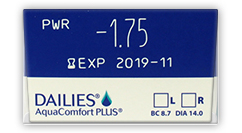
With a basic contact lens prescription you will find all the information on the box - here you can clearly see the power (PWR) is -1.75 and the base curve (B.C) is 8.7 and the diameter (DIA) is 14.0.
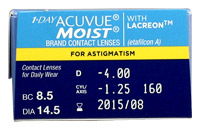
In a more complex toric lens prescription you can still clearly see the B.C (base curve) is 8.5 and the DIA (diameter) is 14.5.
The power in this case (D) is -4.00, the Cyl (cylinder) is -1.25 and the Axis is 160.
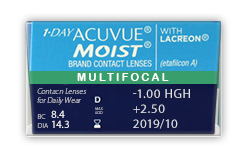
If you need varifocal or multifocal contact lenses you will have extra information on your box, you can still clearly see the B.C (base curve) is 8.4 and the DIA (diameter) is 14.3. The power - in this case (D) is -1.00 High. The 'High' is important as it can be High, Medium or Low and is linked to the Add Power - in this case you will notice the ADD +2.50. A Low add power would typically be under +1.25 and a medium from +1.50 to +2.25.
In all of these cases you can also see the expiry date.
A contact lens prescription can be the same as a prescription for glasses when:
- the prescription is lower power, i.e: -4.00 to +4.00
- there is absolutely no astigmatism present
Are there different types of Contact Lens Prescriptions?
There are three main types of contact lens prescription and depending on your amount of astigmatism you will be prescribed either standard contact lenses, or contact lenses for astigmatism (also called 'Toric lenses').
- If you have astigmatism under 0.50, a regular spherical lens should be prescribed.
- If you have astigmatism of 0.50 to 0.75 can be effectively corrected with an aspheric lens.
- If you have astigmatism greater than 1.00 should be managed with a toric lens.
- If you need reading glasses you will probably require varifocal or multifocal contact lenses contact lens prescription
If your prescription power for glasses is greater than +/-4.00, you should see a difference in the power of your contact lens prescription.
Contact lenses sit on the tear film of your eye so they are much closer than glasses that are approximately 12mm away from your eyes, this means that you normally need weaker power of contact lens than you do glasses, this is particularly true if you have a prescription larger than +/-4.00
Can I use my Glasses Prescription to Buy Contact Lenses?
Unfortunately you cannot use a glasses prescription to buy contact lenses as there will be essential information missing, such as the size of the lens, the curvature of your eye and the type of lens that is best suited for you.
Author: John Dreyer Optometrist Bsc(Hons), MCOPTOM, DipCLP
Created: 28 Apr 2015, Last modified: 15 Feb 2024